
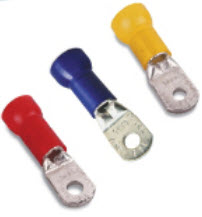
Ring terminals are used in many electrical systems. You can find them in automotive wiring harnesses, marine equipment, aircraft controls and more. As their name suggests, ring terminals feature a ring-shaped piece conductor that “terminates” the end of a wire. You can crimp a ring terminal onto the end of a wire. You can then drive a screw through center of the terminal to secure it to the equipment.
While the conductive ring section often gets the most attention, insulation plays an important role in ring terminals. Here’s everything you need to know about the different types of insulation for ring terminals.
Why Ring Terminals Have Insulation
Ring terminals have insulation to shield and preserve the integrity of their electrical connections. All ring terminals are used in circuits. Circuits, of course, are conductive paths through which electrical current travels.
Without proper insulation, electrical current may accidentally contact nearby metal surfaces and create a short circuit. Moisture, dirt, vibration and excessive heat can also weaken or damage the connection over time. Insulation helps protect the terminal and wire connections so that electrical current remains on its intended path.
Vinyl Insulation
One of the most common types of insulation for ring terminals is vinyl. Vinyl insulation typically consists of polyvinyl chloride (PVC), which is found on the crimp barrel. It’s inexpensive, lightweight and supports a variety of electrical applications.
Vinyl insulation is also flexible, which helps to simplify the installation of ring terminals. You don’t have to use a lot of force to deform vinyl insulation. Rather, it quickly collapses when crimped.
Ring terminals with vinyl insulation are typically color-coded based on their supported wire size.
- Red for 22-18 AWG
- Blue for 16-14 AWG
- Yellow for 12-10 AWG
Nylon Insulation
In addition to vinyl, nylon is commonly used for ring terminal insulation. Like vinyl, nylon is flexible and collapses easily when crimped. Nylon, however, is a more rugged and robust material.
Ring terminals with nylon insulation are more durable than their vinyl-insulated counterparts. They can handle tough environments, including those where vibrations, moisture and extreme temperatures are present.
Another benefit of vinyl insulation is improved visibility. While you can find them in different colors — just like vinyl-insulated ring terminals, nylon-insulated ring terminals are often semi-translucent. You can essentially see through them to determine whether the wire is properly inserted and aligned with the terminal.
Keep in mind that not all ring terminals have insulation. Some of them are bare, meaning the metal barrel is exposed. Non-insulated ring terminals such as this are typically used for specialized applications and require separate insulation.