
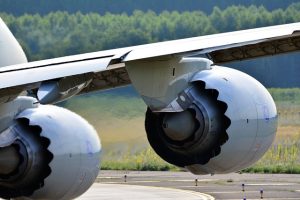
Fuel-air ratios play an important role in the aviation industry. Whether it’s a small Cessna 172 or a jumbo-sized Airbus A380, most airplanes burn a mixture of fuel and air. They feature engines with fuel feed lines and air intakes. Fuel feed lines transfer fuel from the airplane’s storage tank to the engines, whereas air intakes bring air from outside the airplane to the engines.
What Are Fuel-Air Ratios?
Fuel-air ratios represent the mass of fuel entering an engine relative to the mass of air entering the same engine. It’s expressed as a ratio and not a volume due to the fact that air density changes during flight. When an airplane climbs to a higher altitude, for instance, the air will become less dense. Air density also decreases when temperatures increase. Because of these changes, ratios are used to express the mass of fuel to air that enters aircraft engines.
Why Fuel-Air Ratios Matter
Pilots can’t ignore fuel-air ratios. Excessively high ratios will increase engine temperatures. More fuel will enter the engine, causing higher combustion temperatures.
Airplanes will also suffer from poorer fuel efficiency with excessively high fuel-air ratios. They will consume more fuel while flying the same distance. Fuel, of course, is one of the biggest flight-related expenses. Some sources report that it accounts for 30% of a typical commercial airline’s operating expenses. With the right fuel-air ratios, airlines and other aircraft operators can save money.
Excessively low fuel-air ratios can also prove problematic. It can cause unstable combustion or flameout, which increases maintenance time.
Common Fuel-Air Ratios
What’s a typical fuel-air ratio for an airplane exactly? Ratios vary depending on several factors, such as the fuel type, power setting, temperature and more. With that said, most airplanes that run on Avgas burn about 15 parts air per 1 part fuel, meaning the fuel-air ratio is roughly 1:15 (or 15:1 when expressed as an air-fuel ratio).
How Airplanes Control Fuel-Air Ratios
Controlling fuel-air ratios is typically done automatically. Pilots don’t have to manually adjust the mixture. Instead, digital control systems automatically adjust the amount of fuel and air that enters the airplane’s engines.
These control systems adjust fuel-air ratios using various inputs. They will parse data involving airflow, altitude, temperature, throttle, etc. to determine the ideal fuel-air ratio. While it sounds like a complex process, all of this happens in just milliseconds, allowing for the optimal balance of performance and fuel economy.