
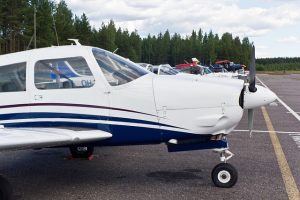
Landing gear assemblies consist of more than wheels and shock absorbers. From small commuter jets to jumbo-sized commercial airliners, most aircraft landing gear assemblies feature torque links as well. They play an important role in stabilizing the wheels during takeoffs and landings.
An Introduction to Torque Links
Torque links are linking rods that connect the two sections of a landing gear strut. They are designed to stabilize and align the wheel. With torque links, airplanes are less likely to experience unwanted wheel movement, such as “shimmying,” when landing or taking off.
Most torque links are made of forged steel or aluminum alloy. Forged steel torque links are particularly strong and durable, but they are heavier than their aluminum alloy counterparts. Therefore, they are commonly used on larger aircraft.
How Torque Links Work
To better understand how torque links work, you must familiarize yourself with the basic components of aircraft landing gear assemblies. Most modern airplanes don’t use springs for shock absorbers. Instead, they use struts, specifically pneumatic struts. Each of these struts has two sections: an upper section and a lower section.
Torque links are used to connect the upper section to the lower section. As shock absorbers, struts will compress under load. Landing, for instance, exposes struts to mechanical stress. To provide a smoother landing, struts will compress. But if the wheel isn’t properly aligned when the strut compresses, it may rapidly oscillate from side to side, which is a serious safety hazard.
By connecting the upper and lower sections of struts, torque links keep wheels aligned — even when the struts compress under heavy loads. They stabilize landing gear assemblies while ensuring the wheels remain straight.
Torque Link Lifespan
Torque links don’t last forever. Like most aircraft components, they have a finite lifespan, which is typically measured in landings or cycles. Aircraft manufacturers generally set these limits for torque links. For some airplanes, the lifespan of a torque link may be 5,000 landings. For others, it may be 9,000 landings.
Torque links will wear out over time. With each landing, they will encounter stress and vibrations, resulting in gradual degradation of components like bearings or bushings. Therefore, aircraft manufacturers often recommend replacing torque links after a specific number of landings or cycles.
In Conclusion
Torque links are an important part of many landing gear assemblies. They connect the upper and lower sections of landing gear struts to stabilize and align the wheels.