
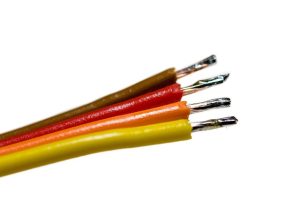
Wire connectors come in a variety of styles. Some of them require nothing more than twisting, such as wing nut connectors. After stripping about 1 inch of insulation off the ends of both wires, you can place the exposed ends inside of a twist-on connector. Turning or twisting the connector clockwise will then cause the exposed ends to wrap around each other.
For a more secure connection, however, you may want to use solder sleeves. Solder sleeves are designed to join multiple wires — just like all wire connectors. Rather than using a twist-based installation process, they use soldering. Here’s everything you need to know about solder sleeves and how they work.
What Are Solder Sleeves?
Solder sleeves are sleeve-like wire connectors that contain solder. They are designed to wrap around wires while simultaneously soldering them together. Once installed, solder sleeves will provide a strong and secure connection between the joined wires.
How Solder Sleeves Work
Solder sleeves are heat-activated. To use them, you’ll need to strip about 1 inch of insulation off the ends of the wires, followed by twisting the exposed ends together. You can then slide a solder sleeve over the twisted section.
You may notice that solder sleeves have several rings. Most of them feature a single solder ring in the center and one heat-activated sealant ring on each end. When using a solder sleeve, you should align the center ring — the solder ring — directly over the twisted section of the wire.
Using a heat gun, apply heat to the solder sleeve. Heat will cause the solder ring to melt so that solder flows onto the wires. Assuming the solder sleeve has sealant rings, it will also activate the sealant, allowing for a more secure connection.
Solder Sleeves vs Heat-Shrink Tubing
Many people assume that solder sleeves are the same as heat-shrink tubing. After all, they both consist of clear tubes, and they are both designed to fit over the ends of exposed wires.
While they look similar and are used for similar purposes, solder sleeves and heat-shrink tubing aren’t the same. Solder sleeves offer an all-in-one solution for joining multiple wires. They don’t require any other steps besides heating. Heat-shrink tubing, on the other hand, typically requires soldering or crimping as an additional step.
Heat-shrink tubing is used mostly for protection. They serve as protective tubes that shield the underlying wires from physical damage, such as abrasion. Before using heat-shrink tubing, you’ll typically need to solder or crimp the wires together. Solder sleeves don’t require soldering or crimping because they already contain solder in the form of a solder ring.