
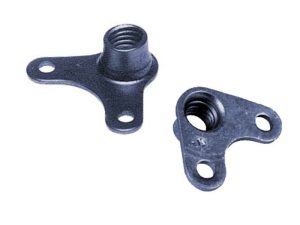
Nutplates are commonly used in airplanes and other types of aircraft. Consisting of a threaded hole — along with one or more mounting holes — they allow for blind fastener installations. You can install bolts with nutplates, for instance, while only accessing the front of the parts through which the bolts are driven.
Nutplates even have a special type of lubricant. Known as dry-film lubricant, it protects the fasteners with which nutplates are used from friction-related damage. What is dry-film lubricant, and why do nutplates have it?
Overview of Dry-Film Lubricant
Dry-film lubricant is exactly what it sounds like: a lubricating coating or film consisting of a dry substance. Like liquid lubricant, dry-film lubricant reduces friction while simultaneously allowing two or more objects to move more smoothly.
How Dry-Film Lubricant Is Made
There are different types of dry-film lubricant, most of which are made using a liquid suspension. Micro-sized particles of a dry lubricating substance are mixed into the liquid suspension. Once applied and cured, the liquid evaporates, leaving behind only the dry lubricating substance in the form of a coating or film.
Common lubricating substances used in dry-film lubricant include:
- Polytetrafluoroethylene (PTFE)
- Graphite
- Molybdenum Disulfide (MoS2)
Why Nutplates Have Dry-Film Lubricant
Nutplates have dry-film lubricant to create a smooth interface between the mating threads. All nutplates have a threaded hole. They are designed for use with a threaded fastener, such as a bolt. After driving a bolt through a set of parts, you can twist the end of the bolt into a properly positioned nutplate.
When twisting a bolt onto a nut, nutplate or any other fastener with interior threading, friction will occur. This friction manifests in the form of resistance that makes it more difficult to install the bolt. At the same time, friction generates heat, which can wear the bolt’s exterior threads or the nutplate’s interior threads.
Dry-film lubricant offers a solution. It creates a smooth film to reduce friction between the bolt and the nutplate.
While liquid lubricant can also reduce friction, dry-film lubricant doesn’t drip or otherwise migrate from its original position. Once applied, it will remain in place. Dry-film lubricant is also better protected against dust and debris. Liquid lubricant can attract dust and debris, resulting in visible clumps. Since dry-film lubricant doesn’t contain any fluid, it won’t attract dust and debris.