
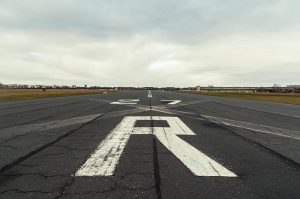
If you’ve ever looked out the window while waiting at an airport, you may recall seeing numbers on the runways. Each runway is assigned a unique number. While some people assume these numbers are random, there’s actually a methodical system to how they are assigned.
Magnetic Heading
Runways are numbered by their magnetic heading. Not to be confused with true heading, magnetic heading represents an object’s direction to the Magnetic North Pole. It’s essentially the angle at which the object, such as an airplane, must turn to point to the Magnetic North Pole. Runways are assigned numbers based on their respective magnetic heading.
For a better understanding of magnetic headings, picture a compass. Compasses span 360 degrees. North equals 360, whereas South equals 180. Runways are numbered using this same principle but with a slight adjustment.
Rounded and Truncated
Runway numbers are both rounded and truncated. They are typically rounded to the nearest 10 degrees, and they are truncated by one digit (the last digit). What does this mean exactly?
If a runway points 356 degrees — just 4 degrees from the Magnetic North Pole — it’s not assigned the number 356. Instead, it’s rounded up to 360, after which it’s truncated by one digit, resulting in the number 36. A runway pointing to 184 degrees, on the other hand, will be assigned the number 18.
Two Numbers Per Runway
Most runways don’t have a single number. Rather, they have two numbers. This is because airplanes often use runways in both directions.
Each end of a runway is assigned a different number. These numbers almost always differ by 18, which represents 180 degrees or a half-circle. A runway with the number 10 on one end, for instance, will typically have the number 28 on the opposite end.
Why Runways Use Magnetic Headings for Numbers
Runways use magnetic headings for numbers because aircraft directional instruments use it. Directional instruments reference the Magnetic North Pole. Heading indicators also reference the Magnetic North Pole. Because directional instruments typically use magnetic headings, runways are numbered based on this information to assist with takeoffs and landings.
When pilots prefer to take off, the heading displayed in the cockpit should match the number on the runway. If the runway is numbered 14, for instance, the airplane’s heading indicator should read 140 (plus or minus 10). Using magnetic headings for numbers makes it easier for pilots to take off and land because the runways match their navigation instruments.