
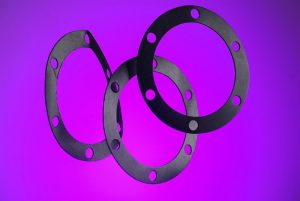
Full face gaskets offer a reliable sealing solution for flat-faced flanges. They are commonly used in piping systems. When pipes connect to a flange surface, they often require a gasket to prevent leaks. The gasket will create an air- and fluid-tight seal. Even if the pipe is pressurized, it shouldn’t leak.
The Basics of Full Face Gaskets
Full face gaskets are mechanical seals that span the entire flange surface or “face” of the pipe with which they are used. They match the inner and outer diameter of the flange. Full face gaskets even have precut holes for bolts.
Full face gaskets are installed between two flanges. The flange surfaces are initially cleaned, after which the gasket is aligned between them. Next, holes are tightened through the flanges and gasket at the proper torque.
Full Face Gaskets vs Ring Gaskets
While they are both used to seal pipe mating surfaces, full face gaskets and ring gaskets aren’t the same. Ring gaskets are typically smaller because they only match the inner diameter of the flange. They don’t have holes for bolts. Instead, ring gaskets only seal the inner portion of the flange. Full face gaskets are larger because they cover the entire flange surface and, therefore, include holes for bolts.
Improved Force Distribution
When compared to ring gaskets, full face gaskets offer better force distribution. Gaskets operate under compressive forces. When you bolt two flanges together, the gasket between them will compress. This compression allows gaskets to seal micro-sized irregularities to prevent leaks.
Full-face gaskets span the entire flange surface. As a result, compressive forces are distributed across a larger area. And by distributing compressive forces across a larger area, full-face gaskets are better protected from localized leaks and warping.
What Are Full Face Gaskets Made Of?
You can find full face gaskets in a variety of materials, each of which has its own unique properties. There are Ethylene Propylene Diene Monomer (EPDM) full face gaskets. They tend to work well in water-based piping systems.
Some full face gaskets are made of neoprene. A typical of synthetic rubber, neoprene is resistant to oils and chemicals while offering excellent elasticity. You can also find full face gaskets made of nitrile. Nitrile gaskets offer a superior level of protection from petroleum.
In Conclusion
Full face gaskets play an important role in piping systems. They cover the entire flange surface to ensure a tight seal. By spreading compressive force evenly, full face gaskets reduce the risk of leaks and damage.