
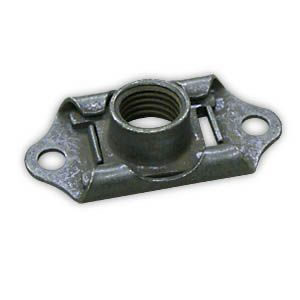
If you’re planning to use an anchor nut, you’ll need to choose the right type. Also known as plate nuts, anchor nuts support blind fastener installations. They allow threaded fasteners to be installed, as well as removed, from a single side of the joined parts.
#1) Fixed
Fixed anchor nuts are characterized by an immobile threaded section. All anchor nuts have a section with interior threading in the center; it acts as a receptacle for a threaded fastener. Fixed anchor nuts have a stationary threaded section that doesn’t move.
#2) Floating
There are also floating anchor nuts. They differ from fixed anchor nuts by featuring a movable threaded section. The threaded section allows for slight movement. With their movable threaded section, floating anchor nuts simplify the process of installing fasteners. Even if the fastener isn’t perfectly aligned with the floating anchor nut, it may still fit.
#3) Dry Film
Dry film anchor nuts are distinguished from other types of anchor nuts by a special “dry film” lubricant. They feature a dry substance, such as graphite. This lubricant reduces friction between and protects against corrosion.
#4) Capped
While most anchor nuts feature an open design, some of them are closed. Known as capped anchor nuts, they protect parts from fastener-related damage. Capped anchor nuts have a closed back to their threaded section. Therefore, you can’t accidentally twist a fastener through them. The closed back section will restrict the travel distance of the fastener during installation.
#5) One Lug
One lug anchor nuts are characterized by a single mounting hole. They are small and compact. If you’re working with a limited amount of space, you may want to opt for a one lug anchor nut. You can install them by driving a permanent fastener, such as a rivet, through the mounting hole.
#6) Two Lug
Two lug anchor nuts, as you may have guessed, feature two mounting holes. Some of them have a single mounting hole on each side, whereas others have both mounting holes on a single side. Regardless, two lug anchor nuts all have two mounting holes. With double the mounting holes, they typically provide better stability and load distribution than one lug anchor nuts.
In Conclusion
Not all anchor nuts are the same. There are many different types, some of which include fixed, floating, dry film, capped, one lug and two lug. Each type offers a specific advantage, whether it’s the rigid strength of a fixed design, the flexibility of a floating insert or the added protection of a capped or dry film variant.