
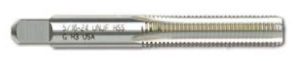
When using machine screws in hard materials like metal, you’ll typically need to tap the threads. Doing so allows for tight tolerances between the screw and the material. The screw’s external threads will closely match and align with the material’s internal threads, ensuring a strong hold. A thread-cutting tap is an essential tool used in this process.
Overview of Thread-Cutting Taps
Thread-cutting taps are mechanical devices used to cut internal threads in materials. They typically consist of several parts, including a shank, cutting edges, chamfer and flutes.
The shank is the smooth section on one end that connects to a tap wrench or machine. The cutting edges are the sharp exterior threads that cut into materials to create internal threads. The chamfer is the tapered section at the opposite end of the shank that guides the tap. Finally, the flutes are vertical channels that move and displace waste material in the form of chips.
You can find thread-cutting taps in different material, some of the most common being aluminum and steel. Aluminum taps are less expensive, but steel taps are stronger and able to cut through harder materials.
How Thread-Cutting Taps Work
Thread-cutting taps work by cutting precise helical ridges or “threads” while simultaneously removing chips. They are designed for use with a tap wrench or machine. After drilling a hole, you can place the thread-cutting tap over the hole and turn it clockwise. As it rotates, the cutting edges will create internal threads while the flutes transport chips to the surface of the hole.
Keep in mind that thread-cutting taps aren’t the same as thread-forming taps. Thread-forming taps are designed to create internal threads by compressing material. They push the material outward to create internal threads. Thread-cutting taps, on the other hand, create internal threads by cutting and removing material.
Different Types of Thread-Cutting Taps
While they are all used to create internal threads by displacing chips, there are different types of thread-cutting taps. Taper taps, for instance, have the longest chamfer. Typically consisting of seven to 10 chamfer threads, they are easy to use and minimize the risk of cross-threading. Plug taps are characterized by a shorter chamfer of three to five threads. They are versatile and used in many applications. Bottoming taps have the shortest chamfer with just one or two threads. They are able to cut very deep threads.