
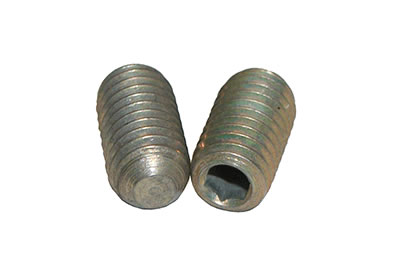
Set screws are commonly used to secure pulleys and gears to shafts. Also known as grub screws, they are characterized by a headless design. Set screws still have a threaded body like standard bolts. Rather than a traditional flared head, however, they feature an internal drive mechanism on one end. Here are five things to consider when choosing a set screw.
#1) Material
Not all set screws are made of the same material. Some of them are made of hardened alloy steel. These heavy-duty set screws are commonly used in structural and mechanical assemblies. There are also set screws made of heat-treated alloy steel. They can often withstand up to 170,000 pounds per square inch (PSI) of pressure. For wet or humid environments, you may want to choose a stainless steel set screw. Stainless steel screws aren’t as strong as their hardened and heat-treated counterparts, but they offer a superior level of protection against corrosion.
#2) Point Type
Set screws are available in different types of points. Some of them have a flat point. Other set screws have a cup point or a cone point. Each point type has its own advantages. Flat-point set screws are better suited for hard surfaces. Cup-point set screws feature sharp edges that dig into surfaces. Cone-point set screws offer the strongest and most secure hold.
#3) Drive Type
You should consider the drive type when choosing a set screw. As previously mentioned, they have an internal drive type. Common drive types for set screws include hex and square. Hex-style set screws have a six-sided recess on one end, whereas square-style set screws have a four-sided recess on one end.
#4) Thread Pitch
The thread pitch represents the distance between a set screw’s individual threads. With SAE measurements, it’s typically measured in threads per inch. A set screw with a thread pitch of 32, for instance, has 32 threads per inch. With metric measurements, thread pitch is measured in millimeters. The higher the thread pitch, the farther apart the screw’s threads will be.
#5) Surface Treatment
What type of surface treatment does the set screw have? For additional protection against chemicals and environmental contaminants, many set screws are coated in a protective layer or finish. Cadmium is commonly used as a surface treatment for set screws. It holds up well in even the toughest environments. Zinc is another popular choice for set screws. It offers good corrosion resistance at a lower cost than many other surface treatment options.